martes, 6 de marzo de 2012

Kayhan Kalhor & Ali Bahrami Fard - I WILL NOT STAND ALONE – 2012 (Iran)

Subido por Guayacas

For most of us in the West classical music calls up visions of men in tuxedos and women in long gowns playing highly formalized and rigidly controlled music. This is the last type of music we'd ever associate with any sort of improvisation as the musicians are there to serve the wishes of the composer as interpreted by the conductor. Unless they're soloists of very high standing they have little or no say in how the music sounds and what it expresses.

So it might come as a bit of shock to find out that the traditions surrounding classical music in other cultures actually encourage improvisation. For, while in countries like India there are certain formal patterns of structure adhered to, within the form there is plenty of room for the musician to interpret the music. The performances of music is considered a personal and spiritual journey, a means of expressing a connection to the gods, so it can't help but change from individual to individual. India is not unique in having this kind of musical tradition, and considering the cross-pollination of culture between the two countries down through history, it's not surprising to find a similar tradition has existed in Iran since the Persian classical music, like many others where there was originally nothing committed to paper, involves a long and involved training period for anybody wishing to perform it. First of all a student has to memorize a canonic repertoire known as radif (literally translated as "order") comprised of over 200 modal pieces of music known as gushehs. These gushehs are grouped together as progressions of modally related pieces into twelve distinct dastgah (systems). Once a musician has memorized all the gushehs individually and collectively in their respective dastgah, they are ready to begin creating. Unlike in the West where we have specific pieces of music to perform, the radif is not something that is actually performed as an individual piece of music, but instead serves as the starting point for creative improvisation.

Of course in listening to music the theory behind it usually flies out the window as you get swept up in the sounds and emotions being generated by the artist in question. Such is the case with I Will Not Stand Alone the latest release from Kayhan Kalhor on World Village Music. The recording features Kalhor playing a variation on the traditional Middle Eastern four-stringed bowed instrument, the kamancheh (called a shah kaman) accompanied by Ali Bahrami Fard on a hammered, dulcimer-type instrument known as a bass santor. If you have any thoughts that the conditions described above for the creation and playing of music were restrictive they will be quickly dispelled as you listen to what these two men are able to generate between them.

Looking at a picture of a kamancheh—the shah kaman has a slightly deeper tone then the original—you'll be amazed at the quality of sound Kalhor is able to create with what looks like a very simple instrument. With only four strings and a resonating chamber made out of a gourd covered by an animal skin, you'd assume its sound would be limited or at least thin. I don't know whether it's the virtuosity of the player or a matter of appearances being deceiving, but on this recording it seems to have the ability to sound like most of the bowed four-stringed instruments in an orchestra. From the heart-stopping emotional clarity of a violin to the rich texture of the cello to the mid tones of the viola, Kalhor not only covers almost the entire musical scale as we know it but its emotional equivalent as well.

Serving as a combination percussion and bass Fard's bass santor not only offers a rich counterpoint and underpinning to Kalhor's playing, he also adds the additional element of being able to emphasize the rhythm through his use of the hammers required to play his instrument. Any expectations we might have as to its limitations based on our experiences of bass instruments in other compositions are quickly dispelled. For Fard does far more than merely play a simple bass line; instead he plays a melodic accompaniment in the lower In the liner notes accompanying the recording Kalhor describes the eight pieces of music as having their origins during a period of unrest in Iran. He's unclear as to whether he's talking about the revolution which saw the overthrow of the Shah back in the 1970s or the more recent period of turbulence and its unsuccessful attempt to push for reforms. Whenever the period, he describes it as one of the most difficult periods in his life, "where darkness and violence seemed to be taking over". Out of this period came the realization that music has the capability to open what he refers to as doors of hope and he made the choice to play his music for the people for this reason. The actual playing and recording of the music was a way for him to break out of the isolation he felt because of the unrest and to connect with those around him—hence the title I Will Not Stand Alone.

Listening to the music after reading these notes one can't help but be struck by how well they capture the journey he took from darkness to light. The titles of individual pieces aren't what you'd call an accurate indication of their musical content; you'd think tunes called "The Laziest Summer Afternoon" or "Dancing Under The Walnut Tree" would be lighthearted and carefree when the former sounds nothing at all like any idle summer day I've ever had and the latter bears no relation whatsoever to dancing. Perhaps something was lost in their translation from the original Farsi, but I think he's commenting on the sense of disconnect he must have felt witnessing scenes of violence and trouble on beautiful summer days. Idyllic conditions have no bearing on how humans behave. It can be a beautiful day and people can still commit atrocities just as easily as if a horrible storm were taking place. The distance between the meaning conveyed by the title of the song and the story the music tells us captures that horrible irony better than anything I've heard before.

Everyone of these pieces has an emotional depth that far outstrips most music we're used to hearing, whether popular or classical. Kalhor has taken the basic skill set required to play Persian classical music to build a collection of pieces that explore both the depths the human spirit can sink to and the heights to which it can ascend. You may have trouble believing this is the work of only two men playing given the multitude of sounds, tones, and emotions they express, but it is indeed only Kalhor and Fard and their two instruments on each track. If you've never experienced non-European classical music this recording will be an eye opener, dispelling any doubts you've ever had of music's capacity to cross cultural and linguistic boundaries. The gulf between the Iranian and Western governments is huge these days. Yet listening to recordings like this one help to remind us that the divide between the people of our respective cultures is far smaller than some would have us think. Richard Marcus - Fuente)

Tracks:
01. Between the heavens and me 14:20
02. Where are you? 11:55
03. The laziest summer afternoon 6:44
04. Dancing under the walnut tree 7:46
05. Hear me cry 3:31
06. Pluck a star from the sky 1:41
07. Here I am alone again 7:15
08. I will not stand alone 5:36


Clave (pass): musicmund
mp3 a 320 kbps

I Will Not Stand Alone

lunes, 5 de marzo de 2012

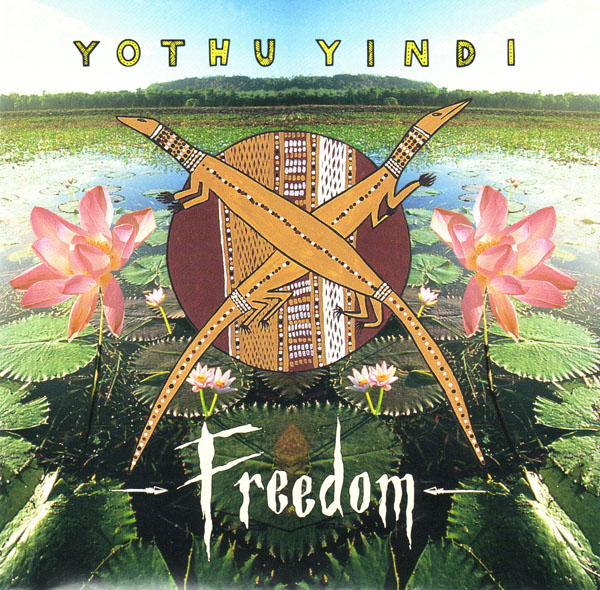
Yothu Yindi - Freedom (1993) [Australia]


Yothu Yindi es un fenómeno australiano. Liderados por el cantante y guitarrista Mandawuy Yunupingti, los Yothus Yolungus son parte (los aborígenes) y balandas parte (que no son aborígenes). Desde su creación hace ocho años la banda de 10 piezas ha cortado una franja independiente, a través principalmente de Australia, de rock orientado a la producción. Reproducción de música tradicional sacudió-para un público diverso, el contenido de la cultura aborigen celebra al mismo tiempo contiene una voz política fuerte. La canción Mabo, por ejemplo, comienza con las palabras 'Terra nullus "- del latín" tierra vacía "- refiriéndose a la vista de los colonizadores europeos falsa del territorio australiano por carecer de la habitación humana.
Este álbum está lleno de relatos de sueños aborígenes, costumbres y sabiduría tribal. El mundo moderno - con sus derechos a la tierra de las campañas - es también cada vez más presente y el sentido de la interconexión de la existencia humana y natural fluye a través de la música. Si los pulsos de didgeridoo se puede comparar a una aceleración del latido cardíaco libertad se convierte en un relato de una fuerza de vida que se niega a ser negada.

La combinación de diferentes géneros musicales que se maneja con destreza. Timeless Land, por ejemplo, las capas de instrumentación moderna y tradicional, con las palabras de una antigua canción de Rirratjingu desde el noreste de Arnhem. Lingüísticamente también este álbum es una mezcla de dialectos Yongu Matha - traducida en la manga - e Inglés.

Freedom es un álbum que se puede bailar, tocar la bocina del didgeridoo jugadores de distancia con el virtuosismo de una Downunder Keith Richards desplazados. Eso Yothu Yindi ha logrado tal éxito sin diluir su mensaje o ser consignado a un gueto musical es un logro admirable que merece una escucha cerca.

MacDonald Daly


1/ Timeless Land (MY,WM,SK,Bridie) 5.10
2/ World of Innocence (MY,Kellaway,Faith) 3.57
3/ Freedom (Yunupingu) 3.05
4/ Baywara (Yunupingu,Kellaway) 4.48
5/ Ngerrk (Traditional) 1.28
6/ Back To Culture (MY,Kellaway,Faith) 3.17
7/ World Turning (Yunupingu,Marika) 4.27
8/ Mabo (MY,GY,Kellaway,GY) 3.24
9/ Milika (Traditional) 0.36
10/ Danggultji (Traditional) 1.14
11/ Gunitjpirr Man (Yunupingu) 3.20
12/ Yolngu Boy (Yunupingu) 4.14
13/ Dots on the Shells (Yunupingu,Finn) 3.20
14/ Our Generation (MY,SK,Farriss) 3.17
15/ Gany 'tjurr (Traditional) 2.16
16/ Gapu (Tidal Mix) (Traditional) 5.11
 

Recorded at Festival Studios, Sydney, Australia, Greenpoint Studio, Brooklyn,
New York Capricorn Studio, Darwin, Australia, EMI 301, Sydney, Australia
and York St. Studios, Auckland, New Zealand
Mixed by Ian Faith at Quad Recording, NY
Mix engineer: David Lumsdaine
Assistant: Mike Anzelowitz
Tracks 2,4,6,7,8,13 & 14 produced by Ian Faith
Original recording and production on tracks 1,3,5,9,10,12 & 15 by Robert
Musso
Additional production on track 1 by Ian Faith
Additional production and arrangements on tracks 3,4,8 & 12 by Bill Laswell
Track 11 produced by Bill Laswell
Track 16 produced by Lamar Lowder


YOTHU YINDI - 
Mandawuy Yunupingu: vocals, guitar; 
Witiyana Marika: vocals, bilma, dance; 
Makuma Yunupingu: yidaki, vocals, bilma; 
Stuart Kellaway: bass; 
Mangatjay Yunupingu: dance; 
Banula Marika: vocals, dance; 
Bunimbirr Marika: yidaki; 
Cal Williams: guitar; 
Natalie Gillespie: vocals; 
Galarrwuy Yunupingu: vocals, bilma, clan leader; 
Mikayngu Mununggurr: yidaki; 
Gurrumul Yunupingu (The Guru): guitar, vocals, keyboards; 
Jodie Cockatoo: vocals; 
ADDITIONAL MUSICIANS - 
Neil Finn (13): vocals; 
Bill Laswell: bass; 
Nicky Skopelitis: 6 & 12 string guitars; 
Bernie Worrell: Hammond B-3 organ; 
Terepai Richmond: drums; 
Huey Benjamin: drums; 
Daniel Watson: percussion; 
Allen Murphy: drums; 
Andrew Belletty: drums.

Tracks 5,15 and 16 arranged by G. Yunupingu
Track 9 arranged by W. Marika


320 kbps + small covers + track list

Yothu Yindi - Freedom

a disfrutarlo!

Chico & Rita (BSO)

Subido por Marhali.

"Chico & Rita" (2010) es la última película animada de Fernando Trueba y Javier Mariscal que narra una historia de amor a ritmo de bolero. Como telón de fondo, un homenaje al cine clásico, a los músicos cubanos, a la vida en La Habana de los años cuarenta y cincuenta y, sobre todo, la música de Bebo Valdés como excepcional banda sonora que recorre el filme en su totalidad.

En la Cuba de finales de los cuarenta, Chico y Rita inician una apasionada historia de amor. Chico es un joven pianista enamorado del jazz y Rita sueña con ser una gran cantante. Desde la noche en que el destino los junta en un baile de La Habana, la vida va uniéndolos y separándolos como si de la letra de un bolero se tratara, esta es la trama de "Chico & Rita".

La película exhala música y comienza con hip-hop en La Habana para enlazar con un "Sabor a mí" ambientado en 1948. A partir de ahí, "Chico & Rita" es un viaje sentimental personal y musical que nos lleva al Tropicana en La Habana, a la Sala Pleyel en París, al Radio City Music Hall en Nueva York, al Village Vanguard, al Palladium… Escenarios míticos en los que aparecen la Orquesta de Woody Herman, Charlie Parker, Chano Pozo, Dizzie Gillespie, Tito Puente, Nat King Cole… Todo esto mezclado con la historia sentimental de Chico y Rita rodeada por mil historias más, desde el asesinato de Chano Pozo a unas deliciosas imágenes que parecen sacadas de Historias de la radio, pasando por la deportación.

Y todo bañado en música grabada única y exclusivamente para la película. "Chico & Rita" se ha grabado con Bebo Valdés, siempre sentado al piano, liderando algunas de las diferentes agrupaciones de músicos que han tocado en el álbum, con canciones y temas instrumentales interpretadas por Bebo Valdés (como Chico), Idania Valdés (Rita), Freddy Cole (Nat King Cole), Jimmy Heath (Ben Webster), Michael P. Mossman (Dizzie Gillespie), Amadito Valdés (Tito Puente), Germán Velazco (Charlie Parker), Yaroldi Abreu (Chano Pozo), Pedrito Martínez (Miguelito Valdés)… y Estrella Morente que canta "Lily", el tema central de la película con Bebo Valdés al piano, Andy González al bajo y Steve Berrios a la batería. Una Estrella Morente de dibujos animados que marca uno de los momentos cumbre de la película, como guiño definitivo y homenaje al gran Bebo Valdés.

Más información: Chico & Rita. Amor, color y música

01. Cachao creador del mambo
02. Blues For Andre (Bebo's Blues)
03. Bésame mucho
04. Con poco coco
05. Ebony Concerto (Allegro Moderato)
06. Persecución
07. Celia
08. Paran pan pan
09. Sabor a mí
10. Ay que mala e
11. Sabor a mí (instrumental)
12. A Mayra (desamor and coda)
13. A Mayra (descarga)
14. A Mayra (sad walk)
15. Chico's Dream -Medley
16. Ecuación
17. Tin tin deo
18. Chano Pozo
19. Nocturno en Batanga
20. Nocturno en Batanga (suite cubana)
21. Love For Sale
22. Love For Sale Reprise
23. A Mayra (Lily)
24. Stardust
25. A Mayra (Lily instrumental)
26. Vanguard Strings
27. Mambo Herd
28. Deportación
29. Lily - con Estrella Morente
30. La bella cubana

BSO


sábado, 3 de marzo de 2012

Kelly Joe Phelps - Sky Like a Broken Clock (Usa - Blues)


“Sky like a broken clock” es el título del cuarto álbum del mago de las seis cuerdas, Kelly Joe Phelps. Si en su anterior album “Shine-eyed mistery Zen” ya lucía su capacidad instrumental y compositora, interpretando los temas con escaso acompañamiento pero con brillante resultado, en este “Sky like a broken clock” Kelly Joe Phelps rodea sus guitarras de una base rítmica de bajo acústico y percusión, arropadas además por órgano, acordeón, cello y armónica. Tal como reza en los créditos del álbum, los diez temas del álbum fueron grabados a la vieja usanza, es decir “en directo” en el estudio, sin ningún tipo de manipulación posterior a la grabación.


La voz de Kelly Joe Phelps es muy personal y suena como un cruce entre Bob Dylan y Tom Waits, aunque con un mayor registro vocal, lo que le permite moverse fácilmente de los tonos más graves a los más agudos, añadiendo riqueza a unas interpretaciones ya adornadas por las contínuas figuras musicales de su guitarra. Phelps bebe de las fuentes del folk y del blues tradicional y sobre ellas incorpora unas letras enigmáticas y llenas de metáforas, a lo Jay Farrar (Son Volt), lo que produce un resultado altamente personal y con unas texturas realmente sugerentes. Este álbum está lleno de grandes temas que van calando con cada escucha, como el que inicia el disco, “Taylor John” (por él sólo ya vale la pena adquirir el álbum), “Clementine”, “Beggar’s oil”, “Tommy”, “Fleashine” o “Worn out”, donde la influencia de Tom Waits es especialmente patente. Absolutamente recomendable para los que gusten descubrir nuevos talentos.
http://www.kellyjoephelps.net/

Tracks

1: Taylor John
2: Clementine
3: Sally Ruby
4: Beggar's Oil
5: Flash Cards
6: Gold Tooth
7: Tommy
8: Fleashine
9: Mr. NY Go
10: Worn Out


Sky Like a Broken Clock

Otis Taylor - White African (2001-Usa-Blues)


Otis Taylor tiene un don para los títulos interesantes; Blue-Eyed Monster y When Negroes Walked the Earth son algunos de los CDs que el músico de Denver ha registrado antes de White African. Taylor también tiene la habilidad para grabar temas muy oscuros y serios esta versión de 2001, está lleno de ellos. En White African, Taylor cuestióna los linchamientos en el Sur Profundo ("Santa Marta Blues") para las personas sin hogar ("Hungry People") por no poder pagar la atención médica de un niño enfermo, ("3 Days and 3 Nights" ). Taylor no trata de disimular sus inquietantes letras con melodías felices. Muy influenciado por John Lee Hooker, el alma de Taylor es muy a menudo temperamental, oscura, inquietantes surcos. White African es tan oscuro musicalmente como líricamente. Con los años, el humor negro ha jugado un papel importante en el blues, los artistas de hip-hop y blues son conocidos por la búsqueda de una variedad de formas de humor inteligente para decir lo cruel de la vida para los negros en Usa. ~ Alex Henderson

Personal:
Otis Taylor (vocals, acoustic guitar, banjo, electric banjo, mandolin, harmonica);
Eddie Turner (guitar, slide guitar);
Kenny Passarelli (keyboards);
Cassie Taylor (background vocals).

1. My Soul's In Louisiana
2. Resurrection Blues
3. Momma Don't You Do It
4. 3 Days And 3 Nights
5. Round And Round
6. Stick On You
7. Rain So Hard
8. Lost My Horse
9. Saint Martha Blues
10. Ain't No Cowgirl
11. Hungry People


White African

ELLIKA & SOLO ''TRETAKT TAKISSABA'' (2002)[SUECIA-SENEGAL]


Uno de los encuentros más refrescantes e inesperados del panorama de las músicas étnicas: Ellika Frisell de Suecia y Solo Cissokho de Senegal. La violinista sueca, ex Filarfolket y Den Fule, conjuga un repertorio tradicional sueco con las notas de la kora del senegalés Solo, proveniente de una conocida y gran familia de griots.


ELLIKA & SOLO
Tretakt takissaba (Xource/Stage Planet)

De una invitación para acompañar a la poesía del poeta africano Luis Faye surgió hace cinco años en Estocolmo el proyecto formado por el griot y músico senegalés afincado en Noruega Solo Cissokho y la violinista nórdica Ellika Frisell. La naturalidad con la que el sonido cristalino de las cuerdas de kora dialogan con las del violín clásico explica el revuelo que la unión de dos tradiciones tan elejadas han causado en el universo de la world music.

fuente


1. Brodkakan/Kodinadioulou 04:12
2. Schottis Efter Per Myhr/Nouria 05:33
3. Takissaba Polska 05:19
4. Mama Tonkara 08:04
5. The Violin Is Waiting for the Kora 06:30
6. Konkoba 05:37
7. Lyckovalsen/Soum Soum 07:02
8. Bingsjopolskan/Dounia 02:31
9. Mambore/Tradgardsvalsen 02:50
10. Lilla Langdansen/Saara 08:29
320 kbps + small covers


NUEVO ENLACE
ELLIKA & SOLO ''TRETAKT TAKISSABA''

a disfrutarlo!

jueves, 1 de marzo de 2012

the rough guide to the music of the balkans (2003) [Balcanes]


Esta colección contiene música de gran encanto y distinción. Si no hay tal cosa como un "sonido balcánico" es una mezcla de diferentes influencias étnicas que van desde las cadencias de Turquía a las antiguas polifonías albaneses.

Música gitana Plus! Un elemento común es que los ritmos suelen ser complejos, así como irresistible movimiento hacia delante. Un ejemplo de todo lo anterior se puede encontrar en la pista ", Mara Djeli" por Saban Bajramovic y respaldado por el muy talentoso Mostar Sevdah Reunion. Empieza lento, con una guitarra acústica, al igual que la apertura de una pieza flamenca. A continuación, una pared de sonidos gitanos se derrumba sobre ti, que suena como klezmer (o tal vez es al revés). Al final, los tambores de establecer un shuffle de que suena como el musette francés. (Otra pista de Mostar en el disco tiene la misma calidad). Ese sonido flamenco se lleva a cabo por Esma Redzepova, un gitano de Macedonia. Ella trae definitivamente que la calidad desgarradora la llamada española "duende" de su canto.

No es posible ir en cada pista, pero hay que mencionar que hay varios números de los anillos de bronce, todos ellos expertos jugado y muy pegadizo. Si usted tiene el más mínimo interés en la música de la región, que debe salir The Rough Guide to the Music de los Balcanes. ~ Kurt Keefner


o1. Djeli Mara - Saban Bajramovic
o2. Pet Je Kumi - Cinkusi
o3. Asfalt Tango - Fanfare Ciocarlia
o4. U Lijepom Starom Gradu Visegradu - Mostar Sevdah Reunion
o5. Nesatova Sa-Sa - Maleshevski Melos
o6. Chaje Skukarije - Esma Redzepova
o7. Disko-Dzummbus - Boban Markovic Orkestar
o8. Jora De La Bolintin - Toni Iordache
o9. Karafili Edhe Zamaki - Gonda Manakovska
10. Belmont - Yuri Yunakov
11. Jarnana - Ayde Mori
12. A Pirin Medley - Angelite
13. Taranjkanje - Marusic Is Trio
14. Trigona - Kristi Stassinopoulou
15. Do Mare Ciften - Ensemble Tirana

320 kbps + covers

NUEVO ENLACE
the rough guide of the balkans

a disfrutarlo!